The Bible is extraordinarily clear that Jesus is our Passover Lamb and the ultimate fulfillment of what the Lord instituted in the Old Testament. Why is this so significant?
In Leviticus 23, God outlines the feasts of the Lord for the children of Israel, and none is without meaning. In fact, every one of these feasts—what the Bible calls “holy convocations”—carries profound significance for all believers today, whether Jew or Gentile.
Here is a brief snapshot of these holy days and their eternal significance:
- The Sabbath: a holy day of solemn rest, a principle that applies to all believers, now and forever (Exodus 20:8–11; Deuteronomy 5:12–15).
- The Passover and Feast of Unleavened Bread: Jesus is our Passover, sacrificed for us (1 Corinthians 5:7), and He was crucified on the very day of Passover. In response, believers are to live “unleavened” lives, holy to the Lord, in sincerity, righteousness, and truth (1 Corinthians 5:6–8).
- The Feast of Firstfruits: Jesus was raised from the dead and became the “firstfruits” of all who have died in Him, giving us hope of eternal life (1 Corinthians 15:20–23). He rose on the very day this feast was observed.
- The Feast of Weeks (Pentecost): the day the Holy Spirit was poured out and the New Testament Church was birthed (Acts 2).
- The Feast of Trumpets: pointing to the second coming of Jesus, when a trumpet will sound and the Lord will return, gathering His people (Matthew 24:29–31; 1 Corinthians 15:50–52).
- The Day of Atonement: fulfilled by Jesus, our High Priest, who made atonement through His own blood, giving us access into God’s presence (Hebrews 9:6–16; 10:11–14).
- The Feast of Tabernacles: Jesus, during this feast, made clear declarations revealing Himself as the Messiah and promising the gift of the Holy Spirit (John 7:1, 37–42).
Let’s take a closer look at Passover.
Christ, Our Passover
“For indeed Christ, our Passover, was sacrificed for us”. 1 Corinthians 5:7
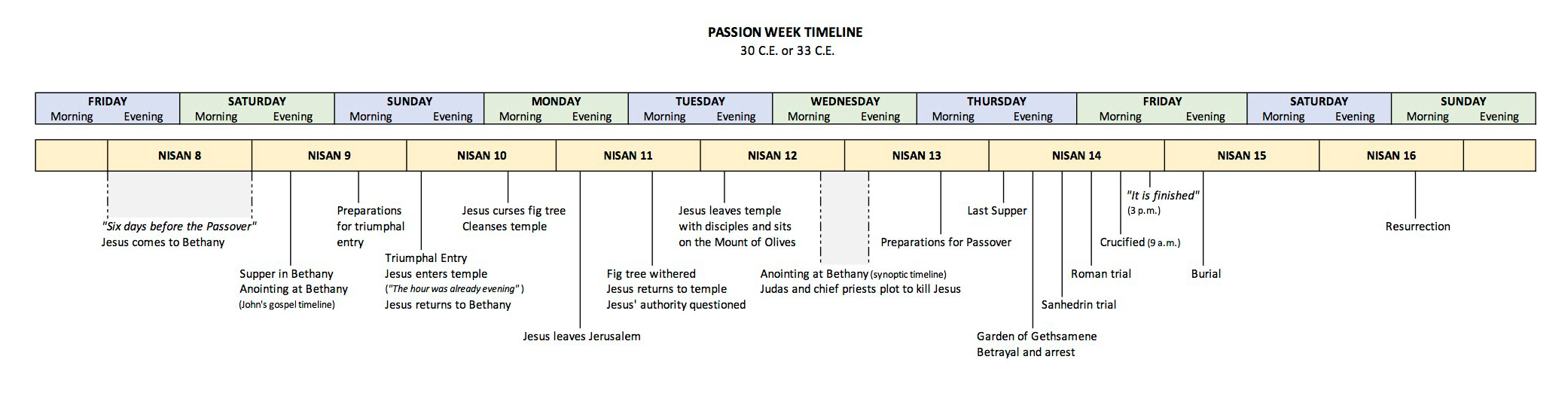
Jesus is our Passover Lamb and the ultimate fulfillment of this holy day, and there is compelling evidence that He fulfilled it on the exact days God originally established. While the precise dates are not essential, and scholars differ, it remains a fascinating study. Click here to view a timeline.
Regarding Passover, God designated two key dates: the tenth and fourteenth days of the first Jewish month, Abib or Nisan (Exodus 12:2–3, 6). On the tenth day, each household was to select a Passover lamb in preparation for the sacrifice. Many scholars believe this was the very date of Jesus’ triumphal entry into Jerusalem. On that day, crowds welcomed Him with palm branches, announcing a Messianic declaration, “Hosanna! Blessed is He who comes in the name of the Lord! The King of Israel” (John 12:12–13). On that day, Jesus, the Passover Lamb, was clearly displayed to the world, a beautiful fulfillment of God’s instructions regarding the Passover lamb. Today, Christians observe the day as Palm Sunday, and millions have received Jesus as their Passover Lamb. May the Church continue presenting Jesus to the world, enabling many more to receive and accept who He is and what He has done.
Then God commanded that on the fourteenth day, the Passover lamb must be killed. According to the Gospels, Jesus was crucified on the very day of Passover. He was crucified at the third hour (9 a.m.) and died at the ninth hour (3 p.m.), during the preparation for Passover. The precise timing of Jesus’ crucifixion is extraordinary when viewed in the context of Passover. While the chief priests were busy preparing to sacrifice the Passover lambs, Jesus was nailed to the cross. Six hours later, as the priests began killing the Passover lambs, Jesus cried out with a loud voice, “It is finished,” and died as the true Passover Lamb. What an extraordinary fulfillment of Bible prophecy! Today, Christians all over the world observe the day as Good Friday.
Even if some historical details are disputed, one truth is unmistakable: Jesus is indeed our Passover Lamb and the ultimate fulfillment of what God Himself instituted. “For indeed, Christ, our Passover, was sacrificed for us” (1 Corinthians 5:7).
Why does this matter?
Redemption
God revealed something quite extraordinary during the initial Passover.
While the children of Israel were observing the first Passover, God said, “Consecrate to Me all the firstborn, whatever opens the womb among the children of Israel, both of man and beast; it is Mine” (Exodus 13:2). And again, “…set apart to the Lord all that open the womb… every firstborn… the males shall be the Lord’s. But every firstborn of a donkey you shall redeem with a lamb; and if you will not redeem it, then you shall break its neck. And all the firstborn of your sons you shall redeem” (v. 13).
The purpose is clear. This holy day is about redemption.
God revisits the same theme of redemption in Exodus 34, again within the context of the Passover and the Feast of Unleavened Bread. “The Feast of Unleavened Bread you shall keep… in the month of Abib you came out of Egypt. All that open the womb are Mine… every male firstborn among your livestock… But the firstborn of a donkey you shall redeem with a lamb. And if you will not redeem him, then you shall break his neck. All the firstborn of your sons you shall redeem” (v. 18-20). The pattern is unmistakable.
But what is the significance?
The Hebrew concept of redemption means to redeem, to buy back, to release from bondage or ownership, to pay a price that brings freedom. In many contexts, it carries the idea of salvation, being rescued from sin and brought into relationship with God.
Regarding Passover, God clearly displayed redemption in a vivid and intentional way. All firstborn belong to Him. But not all firstborn are clean. Clean animals may be sacrificed, but an unclean animal, like a donkey, must be redeemed by a lamb. If no lamb is provided, it must die. This same principle applies to the firstborn sons. They must be redeemed by a lamb. God clearly established that the Passover lamb is an acceptable offering and sacrifice, but not a donkey. The donkey is unclean, unfit to be offered. Yet, remarkably, God had no desire for the donkey to die. Instead, He provided a way. The donkey could be redeemed by a lamb. In other words, for the donkey to live freely, a lamb must die in its place. But if the donkey is not redeemed, if no lamb is provided, its neck must be broken. It will die.
So the principle is clear. Unless redeemed by a lamb, the donkey must die.
What does this have to do with Jesus?
Christ, Our Redeemer
“For indeed, Christ, our Passover, was sacrificed for us.” 1 Corinthians 5:7
John the Baptist said of Jesus, “Behold, the Lamb of God, who takes away the sin of the world” (John 1:29), and again, “Behold, the Lamb of God” (v. 36). Throughout Scripture, even into Revelation, Jesus is identified as the Lamb of God.
Now consider the triumphal entry. All four gospels record that when Jesus, the Lamb of God, was entering Jerusalem on the very week He would be crucified, He was riding on—notice—a donkey. Think about it. The Lamb of God riding on a donkey. Coincidence? Not a chance! In quoting Zechariah 9:9, Matthew’s gospel says, “Tell the daughter of Zion, ‘Behold, your king is coming to you, lowly and sitting on a donkey, a colt, the foal of a donkey.” This event was intentionally orchestrated by God.
In light of Exodus 13 and 34, the picture is beautiful. The Lamb of God will pay the price to redeem mankind. Jesus Himself, our Passover Lamb, will die in place of a people born in sin, to redeem us.
Scripture confirms this again and again. “Jesus Christ gave Himself for us, that He might redeem us from every lawless deed and purify for Himself His own special people” (Titus 3:13-14), and “you were redeemed… with the precious blood of Christ, as a lamb without blemish and without spot” (1 Peter 1:18-19), perfectly matching the description in Exodus 12:5, “You lamb shall be without blemish.”
We have been redeemed by Jesus Christ, our Passover Lamb. Amen!
And yet, as beautiful as this is, there is another side, a sobering reality. God said that if the donkey is not redeemed, its neck must be broken. In other words, if it is not redeemed, it must die. The same is true for us. Every person who does not accept Jesus as their Passover lamb and redeemer will perish. John 3:16 states both sides very clearly, “For God so loved the world that He gave His only begotten Son, that whoever believes in Him shall not perish but have everlasting life.”
The gift of redemption—Jesus dying in our place—is available to everyone. But it must be believed. It must be received. Otherwise, a person remains in their sin and will perish. But to those who believe and receive this gift, there is eternal life.
Will you receive Jesus as your Passover Lamb?
If you have not made Jesus the Lord of your life, or perhaps you said a prayer some time ago, but for one reason or another you find yourself not truly living for Him, now is the time to respond and fully receive what Jesus provided for you. He has already died in your place. Now it’s your turn to respond. The Bible says that if you confess with your mouth that Jesus is Lord and believe in your heart that God raised Him from the dead, you will be saved. It’s time to receive His gift of redemption and eternal life.
Pray this prayer aloud, and mean it in your heart:
Dear God, thank You for loving Me and tugging at my heart today. I confess that I have sinned and need Your forgiveness. I believe in You and in Your Son, Jesus. I believe in my heart that Jesus died in my place to redeem me and give me eternal life. I believe You raised Him from the dead, and He is alive today. Today, I commit my life to Jesus. I choose this day to follow Him. I know I am not perfect and make mistakes, but I know You love me and will help me become the person You have called me to be. I love You. From this moment forward, I am a follower of Jesus Christ. Amen.
To read more faith-building articles by Tristan Fenholt, click here.
To subscribe and receive new posts via email, click here.
 Tristan Fenholt